Showing posts with label Australia. Show all posts

Sunday, August 7, 2016

DVD Review | Women He's Undressed

After a Fashion
by Thomas Delapa

In today’s dressed-down, flip-flops and uber-casual world, we seldom hear that “clothes make the man” anymore. But in classic Hollywood, fashion not only made the man—and the woman—but it made the movies too.
Where would The Wizard of Oz’s Dorothy Gale be without her ruby slippers, Joan Crawford sans her shoulder pads, Marilyn Monroe less (ahem) her skin-tight gowns or Cary Grant minus those impeccably tailored suits?

Like other low-profile collaborators, especially in our grandiose age of the director as auteur, motion-picture costume directors rarely grab the spotlight and even less the microphone. Classic film fans may be familiar with the celebrated career of Edith Head, but otherwise public knowledge of Hollywood’s leading costume designers is skimpy if not threadbare.

Despite its odd-fitting title, Women He’s Undressed means to makeover that legacy, taking the measure of Australian-born Orry-Kelly, who for three decades was one of Hollywood’s larger-than-life, A-list designers. His career included a long, tempestuous stint at the Warner Bros. studio, dressing such stars as Bette Davis, Humphrey Bogart and Olivia de Havilland, and was crowned by three Oscars for costume design, the last for Some Like It Hot in 1959.
An Australian-made documentary directed by the veteran Gillian Armstrong (Little Women, My Brilliant Career), Undressed won’t win ribbons for opulence, but it does stitch together the life and times of Orry-Kelly, born Orry George Kelly in New South Wales. Armstrong’s style clashes in spots, starting with the fanciful inclusion of her subject (Darren Gilshenan) addressing the camera while paddling in a rowboat. As an allegory of his roiling ups and downs it is, well, a bit out to sea.

As a gay man in Hollywood who rarely hid in the closet—at least among his friends— "Jack" Orry-Kelly was renowned for his talents, tart tongue and artistic tantrums. He could be difficult and demanding, but he managed to navigate the treacherous shores of the studio-system fiefdoms. While most found his boss Jack Warner a tight-fisted, crass (and macho) tyrant, Orry-Kelly formed an uneasy alliance, smoothed over by his long friendship with Warner’s wife, Ann. Undoubtedly his most famous work was with the notoriously prickly Bette Davis, including the brazen “red” ball dress her character flitted about in the 1938’s black-and-white Jezebel

Except for that foundering rowboat, Undressed is outfitted in a conventional style, embroidered with interviews (among them, Jane Fonda and Angela Lansbury), newsreel footage and photos. But it’s also spangled with fascinating tidbits about fashion design in Hollywood’s bygone Golden Age. Especially revealing are the sleight-of-hand tricks Orry-Kelly used to transform diva Davis (she of a large but “limp” bosom) that showed off the positive while cloaking the negative.

Glamour, illusion and fantasy were Orry-Kelly’s stock in trade, but his private life was bold as brass, despite begin hemmed in by a homophobic culture that threatened exposure for anyone—especially men—daring to tip-toe out of the closet. Armstrong and her writer Katherine Thomson sew the villain badge on Englishman Cary Grant (nĂ© Archibald Leach), who turned his back on Orry-Kelly once he became a matinee idol. While it is now well-known that Grant and Western star Randolph Scott lived together as roommates and more, the film speciously suggests that Grant’s subsequent marriages were strictly a cover for his homosexuality.

What’s most durable in Armstrong’s material is the flamboyant character of Orry-Kelly as both artist and survivor. Fired from Warners in 1944, he hit the bottle hard, successfully chased by rehab (“sanatoriums” back then) and surfacing in a wave of comebacks in the 1950s, culminating in the sparkling triumph of Some Like It Hot. Not only did he outfit Marilyn Monroe in those diaphanous, barely-there gowns that seared the screen, but he also dragged cross-dressing Jack Lemmon and Tony Curtis into hilarious movie history.

Orry-Kelly was also a brash and oft-catty wit who was loath to keep his mouth zipped—he famously quipped that “Hell must be filled with beautiful women and no mirrors.” In old Hollywood’s bright firmament, you can still see Orry-Kelly’s twinkling reflection in the timelessly elegant fashions he created. 
 ---------------------------------
8/5/16

Thursday, September 9, 2010

"Animal Kingdom" Is a Roaring Good Aussie Crime Drama


Animal Kingdom (Review)

By Steven Rosen

From Cincinnati CityBeat, Sept. 7, 2010


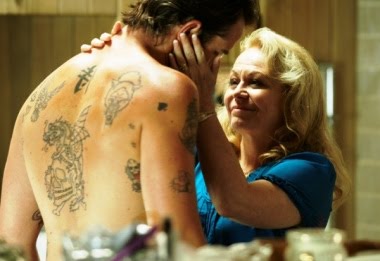
As movie catch phrases go, it’s up there with “I drink your milkshake” from There Will Be Blood. Janine “Smurf” Cody (Jacki Weaver), the Lady MacBethian mother of a dysfunctional family of Melbourne criminals in Animal Kingdom, stares at a crooked cop — her eyes alight with knowingness as she smiles — and states, “And you’ve done some bad things, sweetie.”

God, you think, she seems so delighted to say that, so turned on. What kind of person is she? As played by the late-middle-aged Weaver, a slightly heavier version of Beverly D’Angelo, she’s a blonde-haired matron who is part Carmela Soprano and part Angie Dickinson’s Big Bad Mama.

She’s ultimately very dangerous, yes, but also nice, not imposing or intruding until circumstances demand it. Her domain is a suburban home also occupied by her three adult-age sons, who are involved in armed robbery. Her loving relationship with her troubled sons seems beyond merely supportive — it’s flirtatious.

If the Australian criminal world — and life itself — can really be compared to the animal kingdom, then she is the Lion Queen. And with her colorful wardrobe, she is also part peacock.

Director David Michod and cinematographer Adam Arkapow first shoot her swathed in dramatic blue light — climbing a stairway, slightly out of breath, announcing her arrival.

She has come to an apartment building to rescue her 17-year-old grandson “J,” a tall, quiet young man who, as the film starts, is sitting on the sofa blankly watching a game show while a woman besides him naps. It’s a scene of blissful domestic banality, something out of an R. Crumb comic.

Then, men in uniform stride past the picture window and rap on the screen door. “What’s she taken,” they ask? “Heroin,” he replies. As they unsuccessfully try to revive the slumping woman, he stands by, turning from that scene to the TV. That’s his mother dying, and he’s an innocent lamb lost between illusion and reality.

All alone, he calls grandma Smurf, whom he barely knows — she and her daughter fought years ago over a card game. She cheerily comes and brings him home (she doesn’t seem to care about her daughter’s death) and asks her sons to welcome and protect him.

Her brood tries to, but they are not an easy bunch at accepting strangers. The worst is Andrew, known as “Pope,” a dead-eyed psychotic with a hair-trigger temper, chillingly underplayed by Ben Mendelsohn to exude menace and elicit fear without going over the top.

He subtly taunts fragile, repressed younger brother Darren (Luke Ford). The sleazy, tattooed Craig (Sullivan Stapleton) is a drugged-out loose cannon who’s always close to a meltdown.

The brothers have a friend-in-crime, a handsome family man named Barry Brown (Joel Edgerton, looking like a Disco-era Barry Gibb), who would like to move from this risky profession to the stock market. When something unexpected happens to him, it sets off a chain of uncontrollable events as the clan seeks revenge on those responsible — in this case, some innocent cops. And “J,” still the lamb, has to figure out what to do.

This frames the narrative: Can “J” break free of this toxic family bond to help a paternal police detective (Guy Pearce) bring them to justice? And can he do it soon enough to save his young, rebellious girlfriend Nicki (Laura Wheelwright) from an increasingly depraved “Pope?”

That’s maybe a traditional crime-film story arc, but calling Animal Kingdom a traditional crime film is misleading. It’s not soaked in blood and mayhem at the expense of character development. It doesn’t aspire to the epic sweep of The Godfather or Martin Scorsese’s major mafia dramas. It actually could better be compared with the recent Winter’s Bone — a teenager, left to his own devices by a parent’s desertion, has to negotiate survival in an alien environment where bad people hide in plain sight.

It also heralds the international arrival of a very talented and assured Australian writer/director, Michod. The film won this year’s Grand Jury Prize — Drama in the Sundance Film Festival’s World Cinema competition and is based on a true incident. Michod is very self-assured. Except for some brief narration by “J,” exposition is stripped to a minimum; scenes and plot developments are edited to move as quickly as possible while maintaining overall coherence.

That’s not to say it’s perfect. Michod as screenwriter has trouble establishing the rules of engagement for his characters, especially the police. They act like cold-blooded executioners in some scenes, yet in others are frustrated bureaucrats in the face of legal maneuvering by the Weavers’ corrupt lawyer (Dan Wyllie).

But the director’s feel for naturalism overrides those rough patches. He has a flair for finding the perfect tone for his most audacious scenes. The aforementioned opening one is slow and infused with pathos. However, one that closes the film is sudden, shocking and unforgettable.

Animal Kingdom is unforgettable, too. Grade: A-


--------------------------------------------------------------------------------