Showing posts with label Ethan Coen. Show all posts
Thursday, February 26, 2015
Film Review | Unbroken
To Hell and Back
by Thomas Delapa, Entertainment Voice
While film crowds across the U.S. have practically given “American Sniper ” a ticket-tape parade, the producers of “Unbroken” must be asking themselves why audiences for their valorous World War II drama are in retreat. Cynics might say that trigger-happy screen violence is always a sure shot, while a simple, disarming story of wartime heroism and endurance is likely to miss the box-office bull’s eye. Both pictures recoil from the non-fiction world, but it’s Angelina Jolie‘s directorial breakthrough that merits the longer salute.
What informs Jolie’s deft direction is her obvious passion and empathy for the subject matter—one of the great, if still largely unfamiliar, wartime U.S. survival sagas. Not only did the 26-year-old U.S. track star Louie Zamperini live through 47 dire, shark-infested days clinging to a tiny raft in the Pacific, but his “rescuers” were the Japanese navy, who promptly sailed him off to a succession of some of the most horrific POW camps in the Pacific War. Commendations for bringing Zamperini’s incredible exploits to a new generation’s attention first went to acclaimed author Laura Hillenbrand (“Seabiscuit”) with the 2010 publication of her best-selling biography.
Over the years, a squad of screenwriters made a run at Hillenbrand’s 500-plus page book, the baton ending up with the unlikely team of Oscar winners Joel and Ethan Coen. Serving their source with honor, the Coens zero in on the human drama and jettison their characteristic ironic ballast. Universal also joined up to the tune of a reported $60 million, certainly one of the biggest budgets ever commanded by a female director.
“Unbroken” has taken on some fair flak for echoing a volley of inspirational POW dramas—from “Bridge on the River Kwai” spanning to the uncelebrated “Merry Christmas, Mr. Lawrence.” However, it rises above the potshots, primarily because Jolie keeps her hand steady as she goes towards the truth. She’s also brave in her casting, ditching Hollywood brass in favor of talented unknowns.
Of course, the critical role is Army Lt. Zamperini himself, and the young Brit Jack O’Connell valiantly executes the arduous physical scenes demanded of him. However, there’s an intangible weapon that Jolie brings in, and that’s a wrenching sense of empathy that Louie displays for his battered brother-in-arms. “Lucky” Louie is no beefy John Wayne—or Clint Eastwood—packing a Spartan detachment from the pain of others. He winces when he sees (and hears) his comrades suffering their injuries and imprisonment, even more so than when his own scrawny body is on the line.
Jolie and company can be forgiven for humanely limiting the atrocities they actually portray, and surely worse were meted out in the camps. However, further turns of the screws might have been warranted to counterattack our own superhuman penchant for burying the atrocious shrapnel of the past. As Louie’s whispering Grand Inquisitor camp commander, the Japanese musician Miyavi strikes a memorably savage note (his sadism has a sexual charge) that ranks with the Oscar-winning Sessue Hayakawa in “River Kwai.”
Broken up by flashbacks to Louie’s checkered past as both Italian-American delinquent and 1936 Olympic star, structurally “Unbroken” is nothing to write home about, and might have been sturdier had the supporting characters been built up. There’s no doubt that this is Louie’s epic story, to a fault, while his band of brothers generally stand at attention in the background.
In a Hollywood so incestuously devoted to over-the-top action and the girls-not-allowed club of blockbuster digital effects, Jolie charts her own course, delivering a heady sense of both realism and humanity, ably served by the veteran Roger Deakins’ pristine photography. That “Unbroken” was only decorated with a few minor Oscar nominations is at least a little heartbreaking.
-------------------------------------
Tuesday, May 31, 2011
O Brother, Where Art Thou? (2000)

Bona Fide Funny
by Thomas Delapa
How to describe O Brother, Where Art Thou?, the Coen brothers' latest wild and wooly film fantasy? Ostensibly based on Homer's Odyssey, it attempts to do for the deep South what Fargo did for the upper Midwest, only in a far lighter vein. It may be the only movie to combine Greek myth, bluegrass music, a biblical flood and a Ku Klux Klan rally.
The gods must be smiling on the Coens, for somehow this wacky extravaganza works.
I may live to regret saying this, but I take back almost everything I've said about George Clooney's acting abilities. Discarding his stolid, tough-guy roles, Clooney dusts off a bright, charming comic personality to go along with his matinee-idol good looks.
Clooney plays Ulysses Everett McGill, one of three prisoners who escape a Mississippi chain gang during the Depression 1930s. With him are his dim, down-home cohorts, Delmar (Tim Blake Nelson) and Pete (the wild-eyed John Turturro). As incentive to escape, Everett promises the other two a share of the million dollars he's hidden away from a robbery.
After the Odyssey, the brothers Joel and Ethan take the idea of a husband trekking home to claim his wife after years away. But the Coens also borrow from Sullivan's Travels, Preston Sturges' 1942 screwball comedy which told of a Hollywood director who hobnobs as a hobo to research his upcoming human-interest drama called Oh Brother, Where Art Thou?
You don't need to know Greek to enjoy the misadventures of this trio. Blessed with the gift of pedantic gab, Everett is a cheery optimist who's obsessive about his brand--Dapper Dan--of hair gel. When it comes to winning back the wife (Holly Hunter) who's disowned him, he insists, "But I'm the pater familias" in a manner that suggests Bugs Bunny crossed with Clark Gable.
Clooney's ably supported by Nelson and Turturro as his partners in grime and ex-crime. The dumbest of the bunch, Delmar postulates that Pete was turned into a toad during a close encounter with a threesome of sultry sirens along a riverbank.
Along with Roger Deakins' glowing, golden-hued cinematography is a toe-tapping sprinkling of old folk favorites as the score. Once the boys wander in to a recording studio and serendipitously sing "Man of Constant Sorrow" accompanied a black guitar player (Chris Thomas King), unknown to them they become a sensation on the airwaves. Toward the end, they get to reprise their hit in rambunctious hootenanny wearing false beards.
O Brother might have been better had it ended with its gleeful musical finale. Instead, the Coens bother to add on a deus ex machina flood that washes away some of the buoyant momentum.
Nonetheless, after the big letdown of The Big Lebowski, the Coens are back on top in this terrifically odd but uplifting Depression odyssey.
-----------
Originally published in Boulder Weekly, 1-18-01
Sunday, December 26, 2010
Film Review | True Grit (2010)

No Country for Young Women
by Thomas Delapa
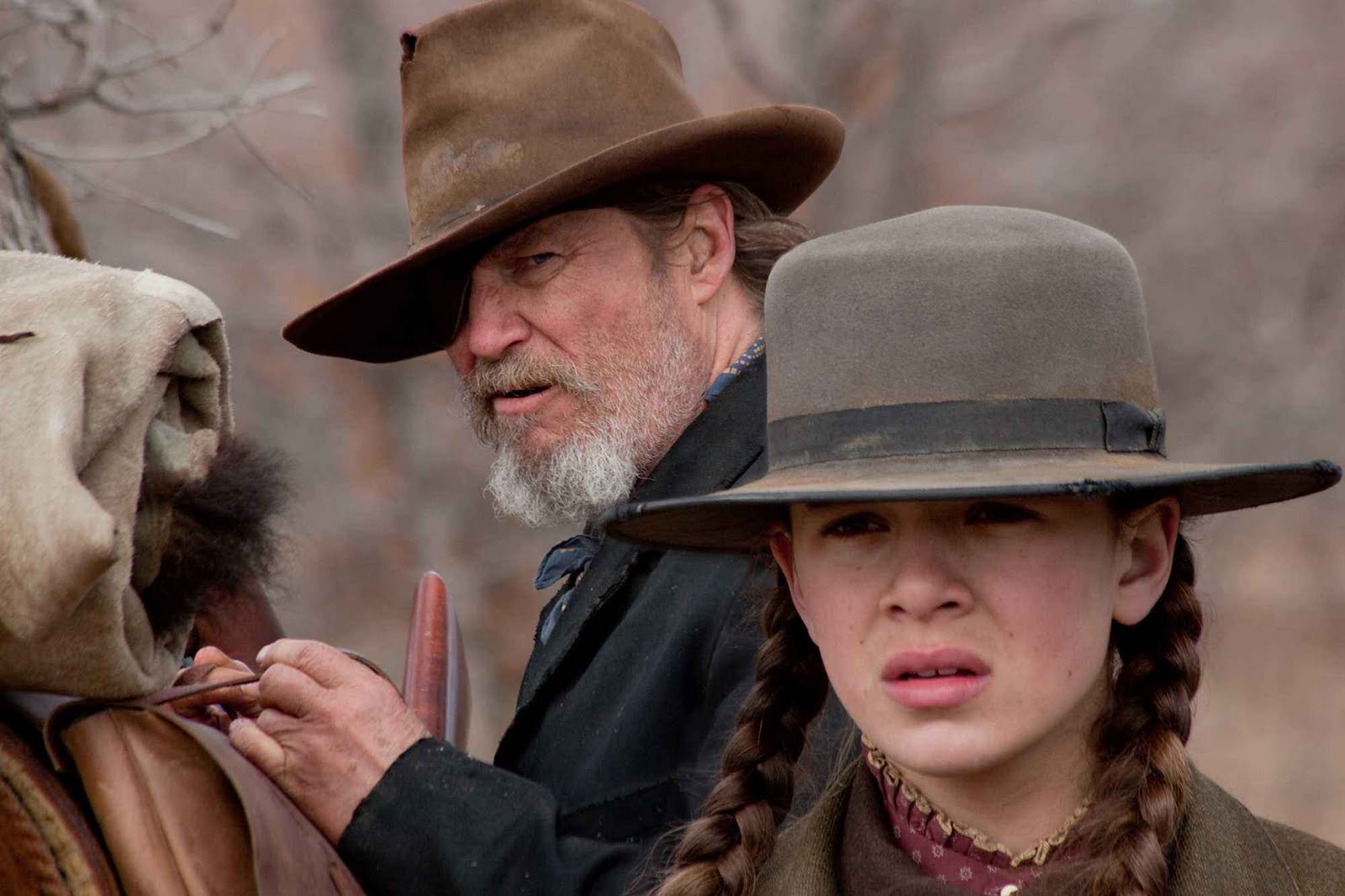
True Grit may not be reckoned a great movie, but it does have a fistful of great scenes—and all of them with young Hailee Steinfeld, sitting tall in the saddle in the Coen brothers’ sprightly Western remake. As a 14-year-old pigtailed whippersnapper hell-bent on revenge, Steinfeld nearly lassos the picture right from under marquee stars Jeff Bridges and Matt Damon.
Old-timers will recollect that John Wayne bagged a Best Actor Oscar for the original 1969 oater, based on Charles Portis’ gem of a novella. As boozy U.S. marshal Reuben “Rooster” Cogburn, the Duke himself had a sharp female foil in Kim Darby, playing the part of the headstrong Mattie Ross out to avenge the murder of her father.
Youngins expecting either a blackly comic or tongue-in-cheek treatment from the brothers Joel and Ethan (Fargo, No Country for Old Men), will be mighty disappointed. Neither bloody nor simple, this is truly an homage, not to any one star in particular, but to the classic Western as whole, from its rugged, wide-screen vistas to the old-school sense of morality and violent retribution.
“There is nothing free except the grace of God,” is how Mattie commences to narrate her neo-biblical quest in the valley of the shadow of death, otherwise known as the Old West. True Grit rises to the heights when it most closely follows the trail of Portis’ language, a richly idiosyncratic blend of colorful prose and quaint 19th-century regionalisms. The “pitiless man who loves to pull a cork” is none other than the ornery, one-eyed Rooster Cogburn, sought out by Mattie to make good on her vendetta. The lowdown varmint they’re after is Tom Chaney (Josh Brolin), rumored to be hiding out with “Lucky” Ned Pepper and his gang.
In an old flour sack, Mattie lugs around a hulking six-shooter that belonged to her father, and she aims to use it on Chaney. But in this mean, windswept country overrun by desperadoes and other bad men, Mattie’s most potent weapon is her tongue. In likely the movie’s best showdown, Mattie puts a few holes in the ego of LaBoeuf (Damon), a puffed-up Texas Ranger who makes the fool mistake of trying to put Mattie in her place. It’s not a hard chore to begin with, but Damon’s low-key, likably simple-minded part will make you forget all about singer Glen Campbell’s sorry misfire in the original.
Toe-to-toe against the towering Hollywood legend of John Wayne, the Oscar-winning Bridges trots out in a different, meandering direction. Sometimes drunk and usually disorderly, Bridges underplays his hand, taking Brando-esque mumbling out on the range, while frequently burying his lines. But this Rooster sobers up and flies right just long enough to do what a man has got to do, especially one with true grit and a dead shot. Mattie isn’t just on a quest for her father’s killer, but a fatherly knight in shining leather.
Shot by cinematographer Roger Deakins in New Mexico and Texas, True Grit rides to the screen as a handsome elegy for the classic Western, but armed with a modernist afterglow on the moral consequences of violence and revenge. In this barren and brutal land, even Mattie has a fall from grace, tumbling down a mineshaft crawling with snakes. In the Eden that once was America, the God-fearing and righteous also succumb.
------------
12/26/10
Subscribe to:
Posts (Atom)