Old Jack City
by Thomas Delapa
Jack Nicholson, Leonardo DiCaprio, Matt Damon and a cast of seven robbing hoods. The Boston underworld. Director Martin Scorsese. Now that you've seen the bad-ass ads for The Departed, I know what all youse wiseguys are thinking: a mob movie in the tradition of GoodFellas.
Well, you can fuhgetaboutit. Redolent of four-letter words, Scorsese's flatulent Boston massacre doesn't amount to hill of beans. Count me among those who wished to depart from The Departed before it was over.
Perhaps still smarting from The Aviator's Oscar snub, Scorsese has landed with bloody vengeance back on his home turf in the gangster flick. But this is easily his worst film since Cape Fear. How bad is GoodFellas Does Boston? So bad that even Jack Nicholson is a deadly bore.
When we first see Nicholson as sleazy gangland boss Frank Costello, he's slithering into a dark cafe, sporting a grizzled goatee and armed with insinuating sexual language. Nicholson's accompanied on the soundtrack by the Rolling Stones' "Gimme Shelter," helping to cue us in that Costello is, by golly, the devil. At least Scorsese mercifully delivers us from "Sympathy for the Devil."
In William Monahan's script—lifted from the 2002 Hong Kong hit, Infernal Affairs—Boston is a ratty hellhole where you can't tell the difference between the crooks and the cops. That's literally true when it comes to Billy Costigan (DiCaprio), a troubled rookie policeman who's assigned to infiltrate Costello's gang. Costigan's cop doppelganger is Colin Sullivan (Damon), who in actuality is Costello's top mole in the state police.
Scorsese and Monahan pile on the bodies and four-letter words with a nihilistic glee that might even cause Tony Soprano to run to confession. Somewhere among the scumbags, dickheads and fucksticks (that's a new one), Monahan's lamebrain script wants to connect the corpses in a study of how gangland crime is rooted in a perverse sense of family obligation. Gee, and I thought I was just watching a Scorsese snuff film.
Beginning with his miscasting in Gangs of New York, DiCaprio has let his own fixation with Scorsese as his screen daddy take him down a dark Steadicam path. With the exception of an admirably subdued Alec Baldwin, all the actors in this movie seem to be juiced on testosterone shots from Floyd Landis' doctor. The unwritten mobster dialogue here isn't "Top of world, Ma!" but rather, "Look how tough I am, Ma, I'm in a Scorsese movie!"
Not only is Scorsese repeating himself in self-parody, but even his usual flair for pop music sounds a death knell. Alongside "Gimme Shelter" (twice) and Patsy Cline's "Crazy" (twice), composer Howard Shore can only contribute a limp background score. Veteran cinematographer Michael Ballhaus' camera is as dead as Costello's numbing parade of victims, including one who falls splat from five stories up at DiCaprio's feet.
Buried within Monahan's script is a relevant 9/11-era theme about the absurd turf wars waging between city, state and federal crime agencies. In one attempt after another to collar Costello, the police bungle the arrest, looking like the Keystone Cops in plainclothes. That Costello may be an FBI informant further blurs the lines of cop and criminality, adding to the witches' brew.
But Scorsese lets his cast play everything at a fever pitch in overheated confrontations that boil over with random acts of brutality. Loosely based on the notorious mob exploits of "Whitey" Bulger, The Departed is no departure for Nicholson, who riffs on all his past Satanic-majesty roles, from The Witches of Eastwick to The Shining.
An ugly 2 1/2-hour whack-fest, The Departed left me hoping that Scorsese will never darken the screen with another gangster movie again.
--------
Originally published in Boulder Weekly, 10/12/06
[Postscript: The Departed won the Best Picture and Best Director Oscars for 2006.]
Showing posts with label Matt Damon. Show all posts
Showing posts with label Matt Damon. Show all posts
Monday, March 19, 2012


Tuesday, March 8, 2011
Film Review | The Adjustment Bureau

Hold on to Your Hats
by Thomas Delapa
Science fiction fans, heed the warning: Whatever you do, don’t confuse The Adjustment Bureau with Blade Runner. Though both films evolved from Philip K. Dick stories, only the now-classic Blade Runner is the real deal. Now showing (likely briefly), The Adjustment Bureau is but a sci-fi replicant, and a dull, maladjusted one at that.
A Bourne Identity without an identity, The Matrix without any cool tricks, Bureau features a hollow, bottom-drawer performance by Matt Damon. He plays David Norris, a budding, post-partisan U.S. Senate candidate from New York who has a close encounter with a dapper band of supernatural conspirators. Do we humans have free will, or are we simply meat puppets blind to the strings of predestined fate?
Like last year’s Inception, this is one of those sci-fi fantasies that is constantly explaining—and breaking—its own rules, partly to gloss over the filmmakers’ own inability to make sense of them. To his befuddled consternation, David discovers that his life is rigged, presided over by a shadowy bunch of fedora-clad men in black assigned to make sure he fatefully follows the Big Picture. If humans—or at least good-looking elites like Damon—don’t follow the plan, the Adjusters step in and press the reset button. God forbid, don’t call these guys guardian angels; they’re secularized “case officers.”
Trouble is, David obstinately doesn’t get it. Like Toto, he accidentally sneaks a peak behind the curtain, and sees Richardson (Mad Men’s John Slattery) and the Adjusters at work futzing with the future. David truly goes “off plan” when he insists on chasing after a pretty ballerina, Elise (Emily Blunt), whom he meets by chance—maybe—and is convinced is his soul-mate.
Though writer/director George Nolfi transparently calibrates the film with wistful themes of true love and noble sacrifice, the chemistry between Blunt and Damon hardly registers on the molecular scale. Most in the sketchy cast act like stick figures, mouthing wooden dialogue that sounds like something out of a dim Star Trek episode. Only Terence Stamp, as an ominous high-level Adjuster, raises the stakes, but he’s a momentary blip amidst the low-grade storytelling.
Nolfi’s silly finale might be subtitled “Run for Your Wife,” as Damon makes a mad, marathon dash through the streets and skyscrapers of Manhattan, sporting one of those dopey fedoras. He first must rescue the fatally flabbergasted Elise, as well as find a way to outrun his fate.
Hollywood marketing plans to the contrary, I predict that most human audiences will exercise their free will and walk away from the pedestrian Adjustment Bureau.
-------------
3/8/11
Sunday, December 26, 2010
Film Review | True Grit (2010)
No Country for Young Women
by Thomas Delapa
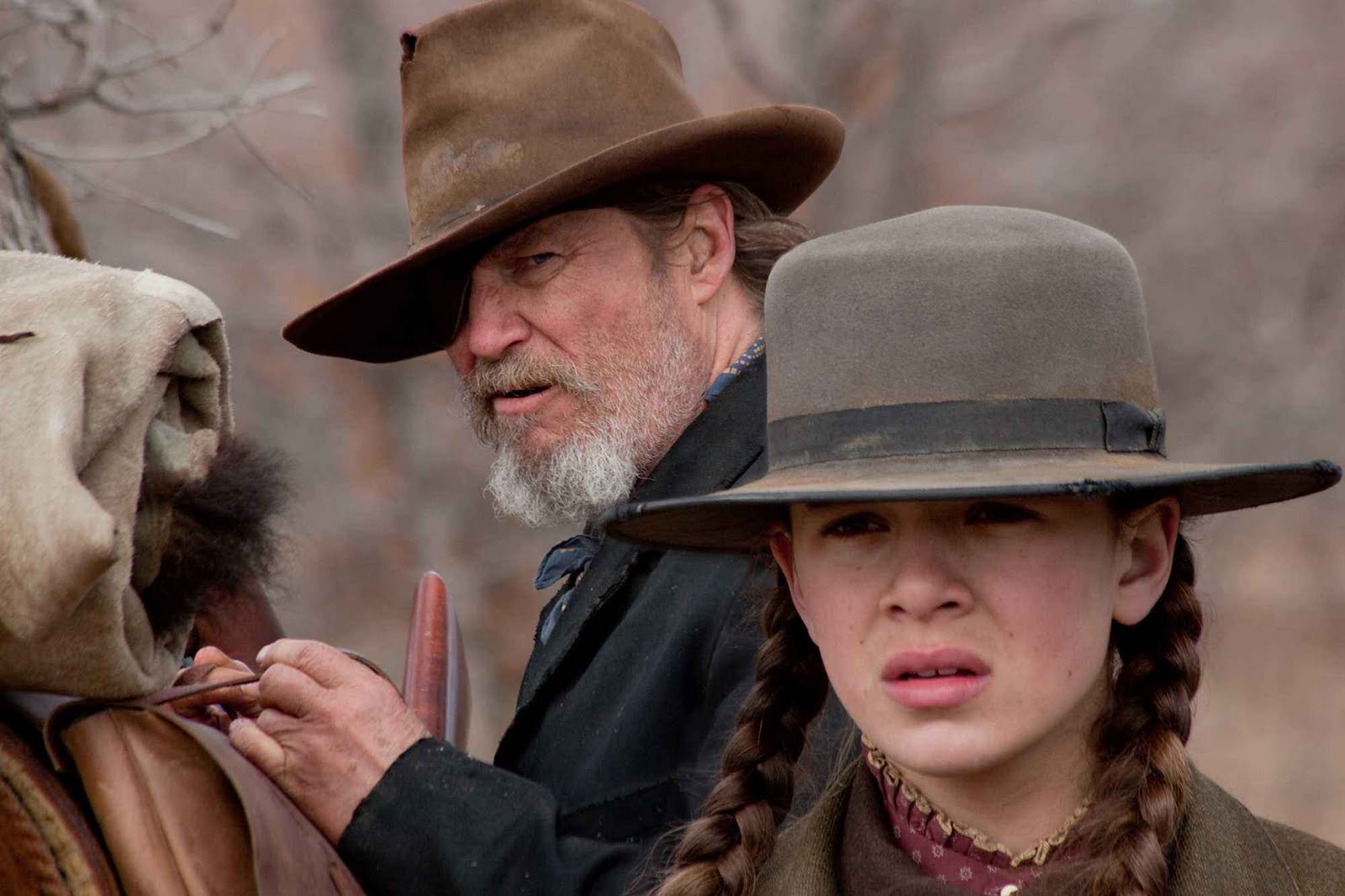
True Grit may not be reckoned a great movie, but it does have a fistful of great scenes—and all of them with young Hailee Steinfeld, sitting tall in the saddle in the Coen brothers’ sprightly Western remake. As a 14-year-old pigtailed whippersnapper hell-bent on revenge, Steinfeld nearly lassos the picture right from under marquee stars Jeff Bridges and Matt Damon.
Old-timers will recollect that John Wayne bagged a Best Actor Oscar for the original 1969 oater, based on Charles Portis’ gem of a novella. As boozy U.S. marshal Reuben “Rooster” Cogburn, the Duke himself had a sharp female foil in Kim Darby, playing the part of the headstrong Mattie Ross out to avenge the murder of her father.
Youngins expecting either a blackly comic or tongue-in-cheek treatment from the brothers Joel and Ethan (Fargo, No Country for Old Men), will be mighty disappointed. Neither bloody nor simple, this is truly an homage, not to any one star in particular, but to the classic Western as whole, from its rugged, wide-screen vistas to the old-school sense of morality and violent retribution.
“There is nothing free except the grace of God,” is how Mattie commences to narrate her neo-biblical quest in the valley of the shadow of death, otherwise known as the Old West. True Grit rises to the heights when it most closely follows the trail of Portis’ language, a richly idiosyncratic blend of colorful prose and quaint 19th-century regionalisms. The “pitiless man who loves to pull a cork” is none other than the ornery, one-eyed Rooster Cogburn, sought out by Mattie to make good on her vendetta. The lowdown varmint they’re after is Tom Chaney (Josh Brolin), rumored to be hiding out with “Lucky” Ned Pepper and his gang.
In an old flour sack, Mattie lugs around a hulking six-shooter that belonged to her father, and she aims to use it on Chaney. But in this mean, windswept country overrun by desperadoes and other bad men, Mattie’s most potent weapon is her tongue. In likely the movie’s best showdown, Mattie puts a few holes in the ego of LaBoeuf (Damon), a puffed-up Texas Ranger who makes the fool mistake of trying to put Mattie in her place. It’s not a hard chore to begin with, but Damon’s low-key, likably simple-minded part will make you forget all about singer Glen Campbell’s sorry misfire in the original.
Toe-to-toe against the towering Hollywood legend of John Wayne, the Oscar-winning Bridges trots out in a different, meandering direction. Sometimes drunk and usually disorderly, Bridges underplays his hand, taking Brando-esque mumbling out on the range, while frequently burying his lines. But this Rooster sobers up and flies right just long enough to do what a man has got to do, especially one with true grit and a dead shot. Mattie isn’t just on a quest for her father’s killer, but a fatherly knight in shining leather.
Shot by cinematographer Roger Deakins in New Mexico and Texas, True Grit rides to the screen as a handsome elegy for the classic Western, but armed with a modernist afterglow on the moral consequences of violence and revenge. In this barren and brutal land, even Mattie has a fall from grace, tumbling down a mineshaft crawling with snakes. In the Eden that once was America, the God-fearing and righteous also succumb.
------------
12/26/10
Thursday, March 18, 2010
Film review | Green Zone

Smart bomb?
by Thomas Delapa
Judging by the deadly initial returns, Jack Nicholson’s “You can’t handle the truth!” might serve as the epitaph for Green Zone, director Paul Greengrass’ fictionalized Iraq War action-thriller about the U.S. search for fictional Iraqi weapons of mass destruction.
Perhaps it was an impossible mission that Greengrass volunteered for in this very loose adaptation of Rajiv Chandrasekaran’s 2006 best seller, Imperial Life in the Emerald City. Though Greengrass enlisted his Bourne Supremacy (and Ultimatum) star Matt Damon, he also got conscripted with a self-destructive script by Brian Helgeland, author of such duds as Man on Fire and The Taking of Pelham 1 2 3 remake. A few days ago, Greengrass optimistically told The Guardian that, “I’m going to see if I can bring the Bourne audience with me.”
Talk about bad intel.
From the opening shots, Green Zone recoils with a demoralizing déjà vu. We know now that the U.S.-led coalition forces never found any WMDs in Iraq, thus destroying a prime justification for the war. No chemical or biological weapons. Ditto on the notorious Nigerian “yellowcake” uranium.
In fact, what Warrant Officer Roy Miller (Damon) and his Army unit find is “nothing but toilet parts” in their 2003 sweep of a vanquished and bombed-out Baghdad. Despite repeated tips of hidden WMDs, Miller starts to suspect that something is rotten in the liberated state of Iraq, and it isn’t spoiled hummus.
In the seven-year itch since the Iraq invasion, Americans of all stripes have had ample opportunity to point fingers, and Greengrass rounds up some of the usual suspects in this conspiracy-movie throwback. Lining up front and center is a shifty Pentagon neocon (Greg Kinnear) who’ll go to any length to defuse allegations of disinformation or cover-up.
While the record shows that coalition forces lost the WMD battle, the liberal-minded Greengrass dispatches Damon on a quest that’s questionable in its own way: Embedded within the historical facts and documentary realism is a counter-intelligent Hollywood action vehicle. It’s notable that cinematographer Barry Ackroyd also shot the Oscar-winning Hurt Locker, a film that continually went AWOL from a believable reality. Green Zone’s techniques quickly speed off into the Greengrass Zone, where shaky cameras and furious editing ambush the storytelling.
What flashes of facts exist, they come in short bursts between the chaotic action scenes, topped by an interminable finale. As Miller, Damon hunkers down with the same sort of magnetic, steely determination that marked Jason Bourne. A loose cannon with a conscience, Miller goes rogue early, tracking down a missing Iraqi general (Yigal Naor) who may be the Sunni side of Deep Throat. Other sideline players include a skeptical CIA chief (Brendan Gleeson) and a Wall Street Journal reporter (Amy Ryan) who stands in for the duped American press.
At some risk (and not just financially), Universal launched this $100 million twilight Zone, which should at least be saluted for setting the record straight in a major motion picture, even if it comes seven years too late. The problem may not just be in Greengrass’ hyped-up Bourne-again style. Maybe this time, it’s the audience, not Jason Bourne, that’s suffering from amnesia.
--------------
Subscribe to:
Posts (Atom)


